Utah Study Blesses Investment in Oakland Coal Terminal But Leaves Key Questions Unanswered
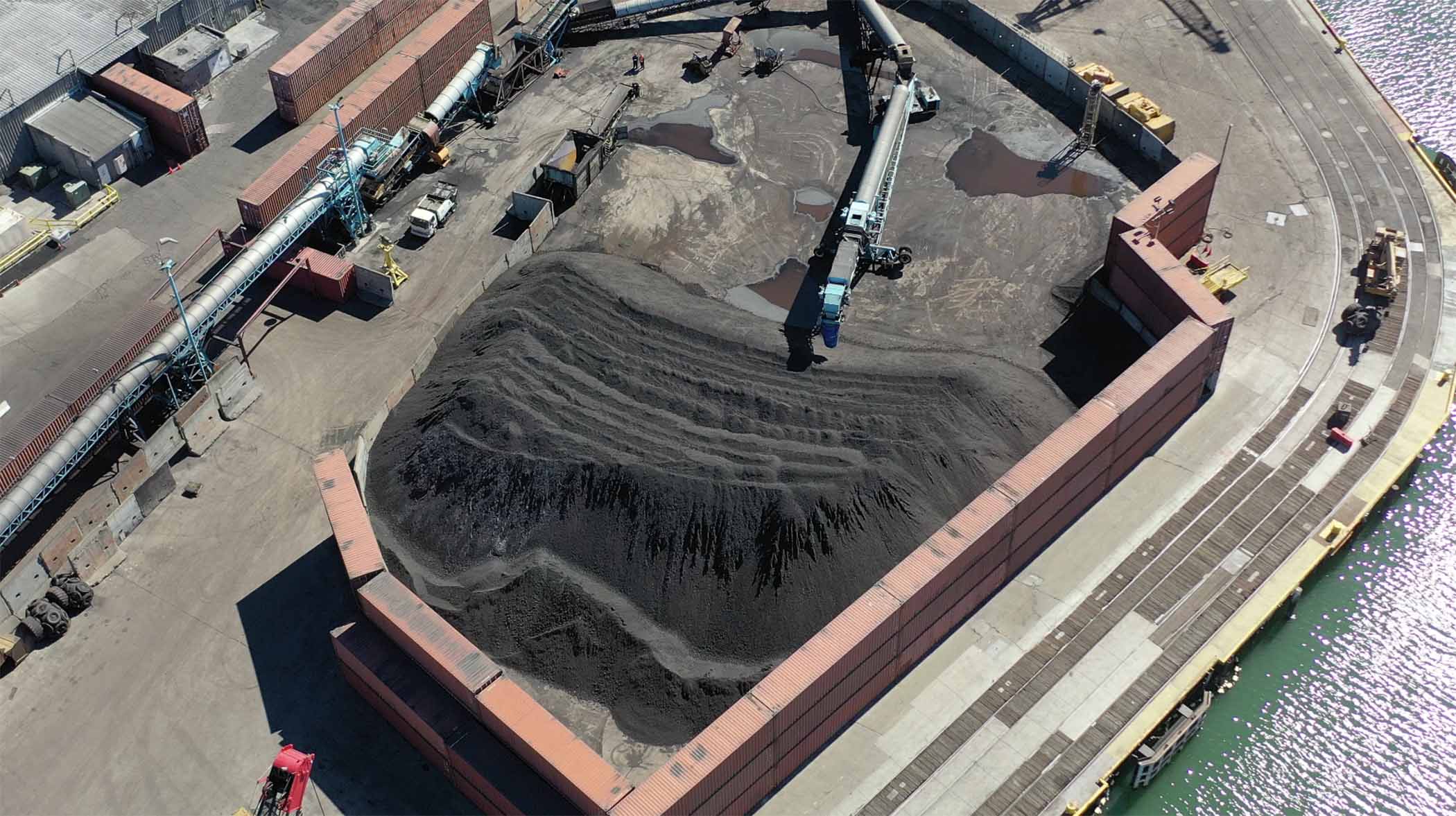
Will Open Piles of Coal in Oakland Replace Open Piles of Coal in Richmond? New Details of Developers’ Plan Emerge
After sitting on a 231-page “feasibility study” of a West Coast coal terminal for more than a month, the eight-county Rural Utah Infrastructure Coalition (RUIC) finally released the engineering and economic analysis on the Saturday of Labor Day weekend, just five days before a public hearing on RUIC”s proposal to invest $40-45 million of Utah public money in the Oakland export facility and another $10 million in a more distant facility in Longview, Washington.
In February of this year, RUIC commissioned Norda Stelo, a giant Canadian-based engineering firm, aided by Wood Mackenzie, a Scottish energy consultancy, “to identify replacement export capacity for Utah coal following the planned closure of the Levin-Richmond terminal at the end of 2026.” (1) The consultants were paid $488,000 to compare three possible locations: Oakland, Longview, and Guaymas, Mexico.
Guaymas was dismissed without much fanfare, and the competition between frontrunner Oakland and also-ran Longview served mainly as a distraction from the question barely addressed in the report: will the Oakland coal export terminal sink under the weight of economic, regulatory, and political risks. If Utah antes, will any other investors come to the table?
The answer is nowhere to be found in the report. The report gave the Oakland terminal project an overall weighted score of 2.85 on a scale of 1 to 5. The grading considered many detailed requirements where 1 indicates the facility does not meet the requirement and 5 indicates it fully meets the requirement. If 5 is an A and 4 is a B, an overall grade of 2.85 is a ho-hum C, not a strong argument for investment. Nonetheless, Norda Stelo recommends that RUIC invest approximately $43 million in Oakland.
The report brings new clarity to what developers have been up to since the project emerged from a decade of litigation in September 2025. Last Thursday, RUIC presented a vague overview of the plan to funding decision makers at Utah’s Community Impact Board and said they would be back as soon as October 1 to apply for the money, but, first, RUIC plans to hold a public hearing in Provo, Utah and online on Thursday, September 10.
As developers seek financial support from Utah for their private coal export scheme, the Norda Stelo report presents a mixture of revelations, questionable claims, and concessions to reality.
Revelations
The developers have no intention of designing a state-of-the-art terminal that will prevent any leakage of coal dust. Coal will be stored in two 150,000-ton open air stockpiles (190), not in “[c]overed bulk material storage buildings” described in the Basis of Design and pictured in the conceptual drawings filed with the City in 2015 and 2018.
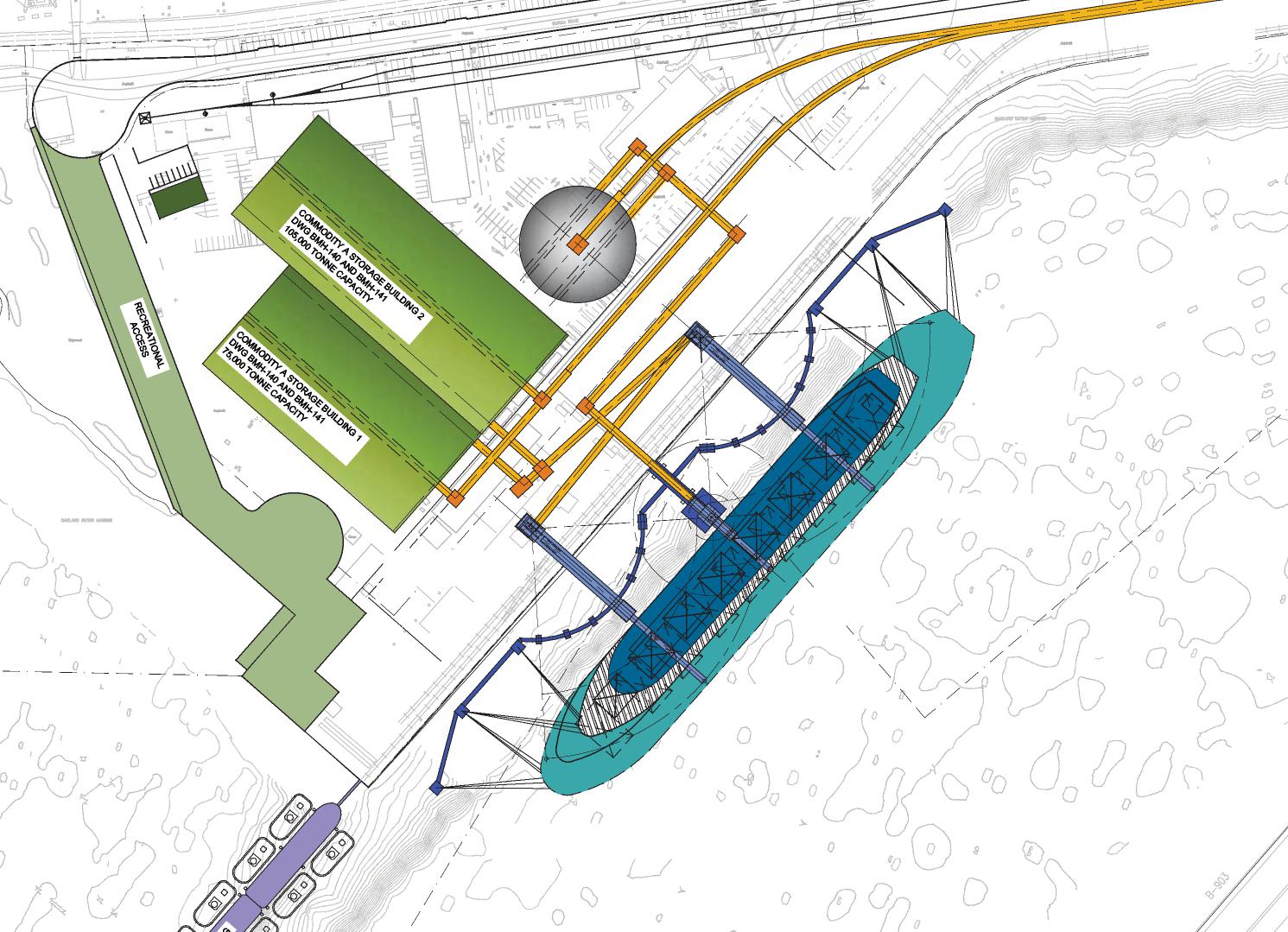
The developers need to raise a lot more cash than they admit. Based on comparable coal terminals of similar throughput and material type, Norda Stelo estimates the cost to build the terminal at $430 to $625 million, not the developers’ cost estimate of $250 million. Norda Stelo notes, without comment, that the developer provided no basis for its estimate “beyond some budgetary vendor quotations.” (18)
If engineering got underway immediately, the terminal might take until 2031 to begin operations. “The overall project duration is estimated at approximately 53 months from the start of engineering to first cargo. As highlighted in Section 4, the OBOT proponent’s October 2028 first-cargo target is not consistent with this schedule.” Apparently, Donald Trump’s boast is false: “Starting this summer, the West Gateway project will break ground, and by summer 2028, over 12 million tons of clean beautiful coal per year will be shipped to countries all around the world.” The West Gateway project does not have a building permit, much less a shovel in the ground, and Norda Stelo estimates it will take more than double the President’s timeline to get a terminal up and running.
The “multi-commodity terminal” is no more; it’s all about coal. OBOT’s developers appear to be quietly ditching their oft-repeated (and contractual?) commitment to build a multi-commodity terminal. The only sharing of the terminal discussed by Norda Stelo is between two varieties of coal: Utah coal and Wyoming Powder River Basin coal. Wood Mackenzie provides a pro forma analysis of other commodities – copper, soda ash, and oil and gas – but serious interest in building a multi-commodity terminal is belied by the report’s sharp focus on coal.
Savage Companies, a large Utah-based logistics firm, has signed up to operate the terminal. Savage has contributed an “OBOT Terminal Project Design Basis” document to the Norda Stelo report along with drawings by Millcreek Engineering.
Delusions and questionable claims
“A coal handling permit is reportedly in place” (19) There is no such thing as a “coal handling permit.” This is a good reminder of Norda Stelo’s warning that their report is based on whatever the developers fed them: “The evaluation of the two facilities is based on information provided by each facility proponent, supplemented by site visit observations and publicly available documentation. No independent verification or detailed condition assessment was performed by Norda Stelo as part of this study.” (8)
“No pending legislative or regulatory changes are identified.” (22) Based on Norda Stelo’s caveat, it is fair to read this as a statement about what Phil Tagami disclosed or failed to disclose to Norda Stelo. As widely reported, on June 15, 2026, six weeks before the Norda Stelo’s report was finalized, Assm. Mia Bonta introduced the Communities First Coal Review Act (AB40) which would require an Environmental Impact Report for any major new coal terminal. The California Legislature has overwhelmingly passed Bonta’s bill and it is awaiting signature on Gov. Newsom’s desk. Moreover, the Bay Area Air District has been in the process of revising its fugitive dust regulations for many months, including specifically those governing “bulk material handling and storage.” Both AB40 and the new Air District regulations may significantly impact the future of the project. Failure to capture these major developments calls into question the reliability of Norda Stelo’s assessment of regulatory risk.
“Oakland [Bulk & Oversized Terminal[ … has substantial public funding support.” (28) “Approximately USD 315 million in public funding has been identified (USD 75 million federal and approximately USD 240 million state).” (19) This is deeply misleading. The $242 million Transport Corridor Improvement Money grant to the City and Port of Oakland covered horizontal redevelopment of the 360-acre Oakland Army Base. It was spent long ago on a rail yard, roads, cleanup, soil compaction, new utilities, and the like. None of this government money was ever available to any of the private developers leasing land from the City or the Port for private benefit. Thus, Norda Stelo’s conclusion that the project has already lined up $315 million dollars of public money is nonsense. That leaves Donald Trump’s pledge to contribute $75 million under the Cold War era Defense Production Act. Trump’s diktat appears legally shaky given the lack of a nexus between shipments of Utah coal to Asia and a legitimate national defense interest.
Silences That Speak Louder Than Words
No interest from private investors is mentioned. In 2015, the pitch to the CIB was done by Jeffrey Holt, an investment banker with Bank of Montreal who suggested that, if Utah would seed the project with $50 million of public money, pension funds could be persuaded to make $200 million of non-recourse loans to fund the project. Now, with as much as $625 million to be raised, the report that is supposed to convince the Community Impact Board to open Utah’s pursestrings provides no assurance that there will be any private investors prepared to close the enormous gap between what public sources might provide and the amount needed to get the project off the ground.
Wood Mackenzie’s economic analysis obscures the secular decline of the overseas coal market. The economic analysis consists of 116 densely packed presentation slides without a coherent narrative to tie them together. There is very little information or analysis of the long-term trends or country-by-country risks that may sink any coal export terminal built at this late point in the world’s transition away from coal.
The study does not show that the market for Utah coal exports “should be profitable for at least 20 years.” Neither does it “confirm” that a West Coast bulk commodities terminal is “a sound and prudent investment for Utah.” These representations by RUIC prior to its visit to the Community Impact Board last Thursday are not supported by the report.
Redactions cover up key facts. Utah law allows agencies to redact trade secrets and other confidential business information from public documents before releasing them, but some of RUIC’s redactions appear designed to cover up inconvenient facts. For example, the list of approvals that “may” be needed by the West Oakland terminal begins with a four-inch black stripe. (20) The developer may dispute one or more items on Norda Stelo’s list, but this does not make it a business secret entitled to be kept from disclosure. The answer to a simple question about what site preparation and demolition work would be required prior to construction is half-redacted. (33) Hardly a trade secret or confidential business information that could lead to competitive harm.
Concessions to reality
“Significant community, permitting, environmental, and schedule risks have been identified” for the Oakland terminal. (27)
“Very strong opposition is documented from community and environmental organisations including No Coal in Oakland, Sierra Club, San Francisco Baykeeper and Earthjustice, with a demonstrated history of litigation and regulatory intervention. A letter dated 13 May was issued by No Coal in Oakland to the Coalition, Norda Stelo and Wood Mackenzie, stating a commitment to oppose the project by ‘every feasible means.'” (20)
The site remains constrained by its geometry. A loop track is the most efficient way to unload a mile-long train. The train pulls in from Utah, enters a loop, dumps its load a couple of cars at a time into a below-grade dumping station, and heads back to Utah without reconfiguration and consequent delay. Here’s the plan for Oakland:
“Railcar movements are based on switching and segmented handling of unit trains using a dedicated switching locomotive. Coal is delivered in 116-car unit trains and, for yard operations, trains are assumed to be broken into two 58-car segments and then further divided into 29-car cuts for unloading. Two parallel tracks are provided at the in-motion bottom-dump system, with one track designated for active dumping while the adjacent track is used for switching and train set-up.” (190)
Notably, there is no room for expansion to service other commodities that do not share the physical characteristics of coal, none of which are identified in the report. “[T]he limited site area provides little opportunity to accommodate additional commodity-specific storage or handling infrastructure.” (15)
Image at top: Aerial view of the Richmond-Level coal terminal, which will retire from coal shipment at the end of 2026. Image credit: SF Baykeeper.
Note: Up to page 28, the page numbers in the text are those shown at the bottom of each page of the Study Report. Higher page numbers refer to the page location within the PDF.