Oakland Doesn’t Have to Choose Between Jobs and Health
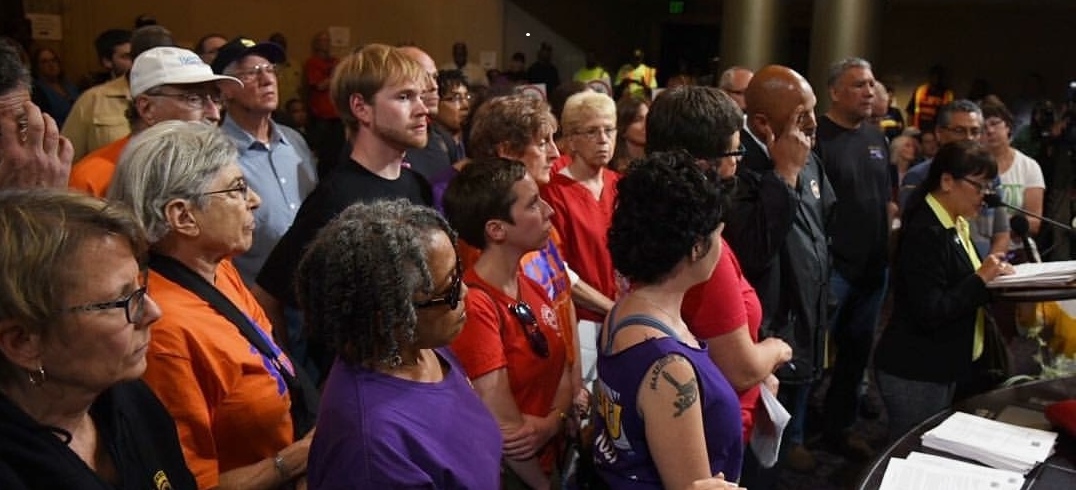
Labor delegation led by Alameda Labor Council leader Josie Camacho speaks out against coal at Oakland City Council meeting | Photo: Brooke Anderson
For years, supporters of coal exports through the former Oakland Army Base have tried to frame the issue as a choice between jobs and the environment. It is a false choice. Workers and communities deserve both good jobs and clean air.
The coalition opposing coal has consistently supported redevelopment of the former Oakland Army Base and the jobs it can create. What we reject is the claim that those jobs depend on exporting coal—or that workers and nearby residents should have to bear the health and environmental costs of coal in exchange for economic opportunity.
What Do the Developers’ Own Numbers Say?
The developers’ own estimates tell a much more complicated story than the large job numbers now being invoked in defense of the coal terminal, especially when you distinguish between permanent jobs operating the terminal and temporary jobs to construct it.
In a 2012 Initial Study/Addendum, the proposed multi-commodity terminal was projected to employ up to 60 International Longshore and Warehouse Union (ILWU) workers. A subsequent economic impact analysis estimated 117 permanent onsite jobs at the bulk commodities terminal. These were estimates of ongoing employment once the terminal was operating, not the temporary workforce needed to build it.
More recent claims have cited much larger employment numbers, but they appear to include or emphasize temporary construction workers. In 2023, terminal operator Insight Terminal Solutions said that construction could create “hundreds of good union jobs,” without providing a specific estimate or underlying analysis. 2023 Insight Terminal Solutions open letter.
Then, in June 2026, as the federal government announced up to $75 million in funding for the terminal, a White House official claimed the project would create more than 1,400 onsite jobs, while supporting thousands more among miners, railroad and port workers, engineers, construction workers, and others across the West. June 2026 news report.
But what exactly does the 1,400 figure measure, and how was it calculated? The Department of Energy’s own description of the West Gateway Terminal Project identifies its federal and private funding, planned capacity, infrastructure, and anticipated timeline—but provides no project-specific job estimate or methodology explaining the 1,400-job claim. Department of Energy project description.
A job estimate might refer to the number of workers employed at the project’s peak, the number of year-long jobs, or the total number of workers employed for the full duration of construction. Without knowing the measure, the headline number explains little about how many people would actually be employed at one time, for how long, or how many permanent jobs would remain once construction is finished.
This is not the first time that large employment numbers have been used to promote the project without clearly distinguishing jobs at the terminal from jobs associated with much broader economic activity. During the earlier political fight over coal, supporters claimed that nearly 12,000 jobs could be lost if Oakland prevented coal exports.
Where did that number come from? It did not represent 12,000 jobs at the coal terminal. Instead, it drew on job estimates associated with redevelopment of the entire former Oakland Army Base, even though the proposed bulk terminal occupies only a small corner of that land.
The problem is that the sources describe different kinds of employment (including highly speculative “indirect.” “off-site,” and “induced” job gains), and the largest recent claims have not come with publicly available sources and methodology. The original environmental and economic analyses identified 60 and 117 permanent onsite jobs, respectively. The latest estimate (“100-150 FTE”) appears in a 2026 report commissioned by the Rural Utah Infrastructure Coalition to support coal country counties applying for public financing of the terminal. The report’s authors explain that the report relies primarily on information provided by developers.
Read our analysis of the “mythical 12,000 jobs.”
Oakland Can Have Jobs Without Coal
The most important point is often lost in the numbers: the terminal was planned as a multi-commodity facility. The jobs to develop and operate the terminal do not inherently require exporting coal.
Oakland does not have to choose between creating good jobs and accepting a coal export terminal. The waterfront can support industries that provide stable, family-supporting union jobs without exposing workers and surrounding communities to unnecessary toxic pollution.
Organized labor has long recognized that distinction. Four Bay Area locals of the International Longshore and Warehouse Union passed resolutions opposing coal exports through Oakland. They joined the Alameda Labor Council and more than a dozen other unions in urging the Oakland City Council to reject the coal plan. Their position reflected a basic principle of environmental and worker justice: economic development should improve the lives of working people, not require them to trade their health for a paycheck.
“Coal is not the right way to bring jobs to Oakland,” said then ILWU Local 10 Business Agent Derrick Muhammad in 2015 when the City Council was first considering the newly discovered plan to ship coal through Oakland. “Oakland families are already worried about asthma and other sicknesses because of highways and port activities. It’s not right to ask them to take on the worry and risk of nine million tons of coal passing through their neighborhoods on trains each year. If the developers haven’t found a cleaner, safer product yet, they owe it to the City of Oakland to make good on their promise and keep looking. They’ll find better cargoes if they are truly committed to bringing good, safe jobs to our community.”
Workers and Communities Are Not Sacrifice Zones
The “jobs versus environment” argument also obscures who bears the costs of polluting industries.
Workers handling coal would face exposure on the job, while residents along transportation routes and near the terminal would live with the pollution generated by moving and storing millions of tons of coal annually. These burdens would fall on communities that have already experienced generations of pollution from freight, industry, highways, and port operations.
Creating jobs should not mean creating sacrifice zones—places where the health of workers and working-class communities is treated as an acceptable cost of doing business.
A job count alone cannot tell us whether development is good for Oakland. The real questions are: What kind of jobs? How long will they last? Who benefits? Who bears the costs? And could those same workers be employed in industries that do not impose those harms?
For the Oakland waterfront, the answer to the last question has always been yes.
Jobs and Health—Not Jobs or Health
Our movement has never accepted the false choice between jobs and health. Oakland deserves redevelopment that creates good union jobs, strengthens the local economy, and protects the people who work and live here.
Coal is not the price Oakland has to pay for jobs.