Coal’s Dangers to Public Health and Safety: FAQ
- How would a coal terminal in Oakland affect air pollution in the Bay Area?
Particulate matter (fugitive coal dust) is emitted into the air through :
- Uncovered coal cars along the entire rail route.
- Shuttling and unloading coal trains into open-air bunkers at the terminal, and loading ships for export to Asia
- Storage and transit of empty coal cars
Diesel-fueled trains and ships serving the terminal also release toxic air pollution.
Developers have proposed shipping up to 10 million tons of coal annually, which works out to two to three trains of 100+ uncovered coal cars (more than a mile long each) arriving at the proposed West Oakland coal terminal and returning to Utah every day for decades to come, shedding coal dust both coming and going.
- How do we know coal trains affect air quality along the route between mining states and West Oakland?
A recent study (Ostro et al. 2023) measured increases in particulate pollution when coal trains passed en route to and from the nearby Levin coal terminal in Richmond and when they were stored, full and empty. The study found significant increases in air pollution, i.e., both fine and coarse particulate matter (PM2.5 and PM10, respectively) due to full cars en route to the Levin terminal, and also due to empty coal cars passing by on their way back to Utah. This air pollution was detected within ½ mile of the train tracks – and further depending on wind and weather conditions. It also found increases in coal dust pollution due to stored, stationary full and empty coal cars. These increases were greater than those produced by either freight or passenger train cars.
The Levin terminal will stop shipping coal by the end of 2026, due to settlement of federal and state lawsuits. The proposed Oakland coal terminal is projected to be much larger, shipping a far greater quantity of coal, so it would cause even more pollution.
- What’s the difference between PM10 and PM2.5, which are both emitted during transport, handling, and storage of coal?
Coarse PM10 particles cause buildup of the oily, grimy coal dust on homes, schools, and cars that people living near the coal terminal in Richmond have endured for years. PM2.5 particles are one-thirtieth the width of a human hair, and are too small to see … so small that they work their way deep into the lungs, cannot be coughed out, and ultimately enter the blood stream where the particles can cause chronic inflammation and other serious health effects, including heart attacks, strokes and death.
- Is there a safe level of exposure to PM2.5?
No. The U.S. Environmental Protection Agency (EPA), California EPA, and the World Health Organization have all indicated there is no “safe level” of exposure to PM2.5. Therefore, the increase in PM2.5 from passing coal trains would be a significant threat to public health all along the rail routes, especially because exposure would continue for years if the West Oakland coal terminal becomes operational.
- How many people would be exposed to increased levels of PM2.5 if a West Oakland coal terminal became operational?
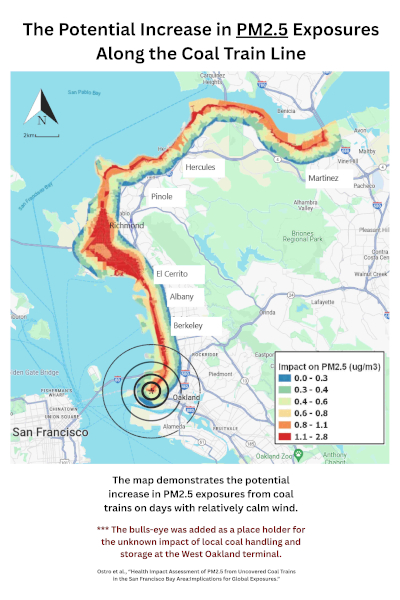
A health impact assessment published in the journal Environmental Research (2024) found that over a quarter million people along the rail route from Martinez to West Oakland (see map) would experience an increase in annual exposure to PM2.5. Alarmingly, large portions of this population are highly vulnerable to the adverse health consequences of PM2.5. Fourteen percent of that group is over age 65, while more than a quarter are children aged less than 18 years. The study ultimately underestimates the full impact of the terminal as it does not quantify populations exposed to coal dust shed by passing trains between Utah (where coal is mined) and Martinez; or along a ‘southern route’ through the East Bay, a possibility discussed below.
- What health impacts would be caused by PM2.5 exposure associated with an operational coal terminal adjacent to the Bay Bridge toll plaza?
Using available epidemiologic studies that determine the risk of PM2.5 for various health outcomes, the 2024 health impact study suggested that residents in the study area would experience 1% to 6% increases in the following adverse outcomes of PM2.5:
- deaths
- hospitalizations for heart and lung disease
- pneumonia
- new asthma cases
- additional asthma attacks
- days of lost work
If developers succeed in their drive to ship coal for the entire term of their lease, these impacts would extend over 66 years.
Not quantified in the list of impacts: school loss days; adverse birth outcomes (e.g., low birth weight, prematurity); neurodevelopment impacts on infants; dementia; Alzheimer’s or Parkinson’s diseases.
Also not quantified in the study: climate change impacts driven by mining and burning coal shipped through the proposed West Oakland terminal.
- What do we know about the areas that would be affected by transport, handling, and storage of coal associated with a West Oakland coal terminal?
The coal terminal will profoundly impact neighborhoods by the terminal itself, like West Oakland, and neighborhoods all along the rail route used to transport coal.
The scientists, who authored The impact of coal trains on PM2.5 in the San Francisco Bay area (2023) extrapolated that coal trains would take a “northern route” through the East Bay, based on the principal route coal trains used for years to transport coal to the Levin Terminal in Richmond, California. That northern route is illustrated on the map below. The map shows how much increased PM2.5 exposure would occur due to dust shed from coal trains (significant increases occur at least up to ½ mile from the tracks).
If coal trains were routed to West Oakland from the south, they would likely pass through Fremont, Union City, Hayward, San Leandro, East Oakland, and Oakland Chinatown.
West Oakland would be most impacted because the proposed terminal and associated port activities would operate there. West Oakland is already overburdened with pollution from freeway traffic, heavy industry, chemical waste, toxic soil, and operations at the Port of Oakland. Already, compared to the county average, lifespan in West Oakland is six years shorter; asthma hospitalizations are 50% higher, and deaths from heart disease are 33% higher than the county average.
The Bay Bridge Toll Plaza is situated about 500 yards from the proposed coal terminal.
- Are there other peer-reviewed scientific studies assessing the effect of a coal terminal on nearby communities?
A 2025 study published by scientists at Johns Hopkins University, Relation of wind direction and coal terminal activity patterns with air pollution burden in a community bordering a coal export terminal, Curtis Bay, Maryland, USA, addresses the impact of a coal terminal at the Port of Baltimore, Maryland and the adjacent neighborhood, a similar situation to West Oakland’s should the coal terminal become operational. From the study’s abstract: “This study aimed to determine how air quality varied in relation to changes in wind direction and observed coal terminal activity.” A press release about the study, on the website of JHU’s Bloomberg School of Public Health summarizes the findings.
Other studies that examine change in PM2.5 due to passing trains include Diesel particulate matter and coal dust from trains in the Columbia River Gorge, Washington State (2015); Impact of coal-carrying trains on particulate matter concentrations in South Delta, British Columbia, Canada (2017); and others cited in The impact of coal trains on PM2.5 in the San Francisco Bay area (2023) by Ostro, et al.
- Where can I find the public health reports and other materials that the Oakland City Council had before them when enacting its coal ordinance and resolution in 2016?
There are many documents submitted to the Oakland City Council in 2015 and 2016; some of them are both long and technical. Of the documents linked below, a good place to start might be NCIO’s and Earthjustice’s 2015 submissions and their expert attachments (NCIO’s are included in its submission; Earthjustice’s by Phyllis Fox, Ph.D. and Deb Niemeier, Ph.D. are accessible separately).
Click the link to access:
- the Public Health Advisory Panel on Coal in Oakland’s report: An Assessment of the Health and Safety Implications of Coal Transport through Oakland (2026-06-14)
- the report prepared by Zoe Chafe, PhD, MPH, for then Oakland City Councilmember Dan Kalb: Analysis of Health Impacts and Safety Risks and Other Issues/Concerns Related to the Transport, Handling, Transloading, and Storage of Coal and/or Petroleum Coke (Petcoke) in Oakland and at the Proposed Oakland Bulk & Oversized Terminal (2016-06-22)
- the report prepared by Environmental Science Associates (ESA), a consulting firm hired by the City of Oakland: Report On The Health And/Or Safety Impacts Associated With The Transport, Storage, And/Or Handling Of Coal And/Or Coke In Oakland, Including At The Proposed Oakland Bulk And Oversized Terminal In The West Gateway Area Of The Former Oakland Army Base (2016-06-23)
- No Coal in Oakland’s comment to the Mayor and City Council on behalf of itself, Sunflower Alliance, 350 Bay Area, System Change Not Climate Change, and West Oakland Neighbors. (September 18, 2015). NCIO’s comment incorporates analyses by Dr. Bart Ostro, former chief of the Air Pollution Epidemiology Section of the California Environmental Protection Agency, and Paul English, Ph.D., a public health epidemiologist with over 25 years of experience in assessing public health impacts of environmental exposures. (September, 2015).
- the letter submitted by Earthjustice to Oakland’s City Administrator, on behalf of itself and Sierra Club, West Oakland Environmental Indicators Project, San Francisco Baykeeper, and Communities for a Better Environment. (September 2, 2015). The Earthjustice letter is supported by extensive health and safety reports by veteran environmental analyst and consulting engineer Phyllis Fox, Ph.D., and University of California Davis professor of civil and environmental engineering Deb Niemeier, Ph.D. (September 2015)
At the City Council meeting on June 27, 2016, Dr. Heather Kuiper of the Public Health Advisory Panel spoke and submitted a handout comparing the findings of the first three studies in the bulleted list, above. That handout was preserved in the early record kept by the City of Oakland, but the link is no longer accessible. Dr. Kuiper’s handout was formerly linked here.