Energy Analysts Call Utah Coal Terminal Funding “A High-Risk Gamble”
A new report by the Institute for Energy Economics and Financial Analysis (IEEFA) calls a plan to spend $54 million of Utah public funds on coal export terminals in Oakland, California, and Longview, Washington, “a high-risk gamble to spend … money on out-of-state projects that could leave rural Utah with limited economic benefits — even if the coal terminals are eventually built.”
EEFA analyzed a recent report commissioned by the Rural Utah Infrastructure Coalition (RUIC) which recommended investing 80% of the funds ($43.2M) in Oakland and the remainder in Longview. IEEFA’s verdict is summed up in the title of its report, “Extensive financial risks and delays loom as Utah considers investing in coal export terminals that would divert funding from in-state needs.”
Ironically, the report commissioned by RUIC to justify investment in coal export terminals is full of red flags in IEEFA’s view:
The [Norda Stelo] report details a multitude of risks for investing in these projects, including:
- Far higher costs, hundreds of millions of dollars more than estimated by advocates
- Construction timelines at least two to three years longer than currently stated
- Lack of well-capitalized, experienced investors, including mining companies, commodity trading firms, or railroads that could see these projects through
- The very early-stage engineering status of the projects, especially Longview, greatly increasing the odds of delays and cost overruns
- Many potential bottlenecks that could sharply curtail export tonnage, including rail congestion, limited and inflexible terminal space, and loading equipment limitations
- International coal market risks
- Organized and influential state and local opposition in both California and Washington that has stopped previously proposed coal export projects
The report by the IEEFA, “which provides independent, evidence-based financial analysis of global energy markets, investment trends, and policies,” aligns closely with analysis of the Norda Stelo report published by No Coal in Oakland on September 8, 2026.
Though it matters very much to West Oakland residents and workers, the IEEFA didn’t comment on the open air stockpiles in which terminal operators plan to store as much as 300,000 tons of coal on the proposed terminal site — scrapping the empty promises and implications in conceptual drawings and legal filings with which developers marketed their dystopian project 8-11 years ago. It’s fair to assume that this looming threat flew under the IEEFA’s radar because the health and safety of Californians is not the State of Utah’s financial concern.
On the other hand, the IEEFA report details project risks that No Coal in Oakland did not raise in its ‘hot off the press’ analysis of the $488,000 RUIC-commissioned study.
For example, IEEFA cited the risk of increase in the already jaw-dropping OBOT construction cost estimate floated by Norda Stelo, reasoning that there are “significant and interrelated risk factors: additional equipment and construction cost inflation, unforeseen engineering challenges, rising interest rates, […] project delays [, and] the extremely limited size of the coal terminal site…”
IEEFA also called out “lack of well-capitalized, experienced investors” as a “financial red flag”; and the Norda Stelo admission that “rail congestion associated with BNSF and UP services to Californian west coast ports is increasing, with dwell times exceeding eight days at several ports” and “two rail bottlenecks near the Donner Pass that have ‘single-track tunnels with potential waiting and weather / rockslide / washout stoppages.’”
The independent IEEFA report then ends with a bang:
At this early stage of development, and given the absence of solid commitments from any financially strong and experienced commercial backers, these projects pose substantial risks to the RUIC’s money—risks that should not be borne by rural citizens of Utah.
The question now is whether Utah’s Community Impact Board (CIB) — the government entity that will decide whether or not to fund the risk-riddled OBOT project — will be gulled by RUIC’s smoke-and-mirror application for over $50,000,000 in public money … or whether they will act in the best interest of the State of Utah.
Stay tuned. The CIB meets next on October 1st, and it’s not yet clear whether they will evaluate the application for funding out-of-state coal terminals at that meeting, or whether RUIC will engineer a delay as the coalition of mining counties licks the wounds inflicted on its case by the IEEFA report.
A full PDF version of the IEEFA report is available here.
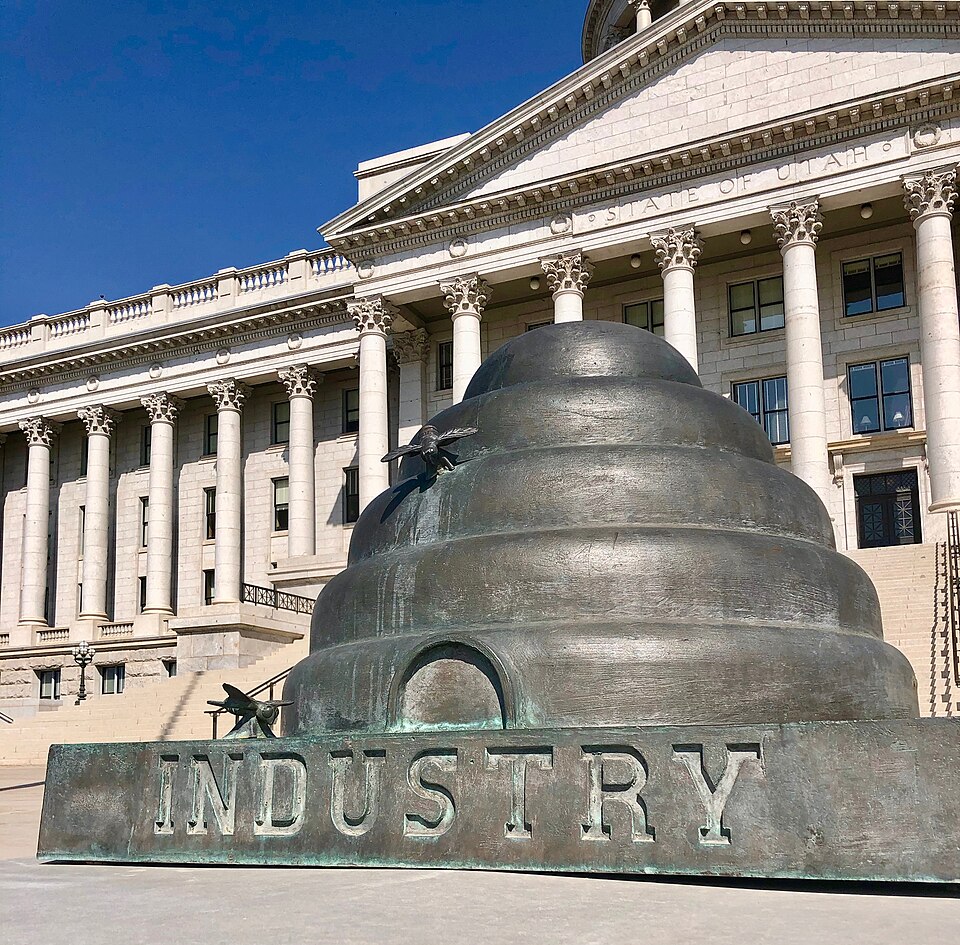
Image: State Capitol of Utah. Image credit: Strobel Adventures, via Wikimedia, CC BY-SA 4.0.