Why a West Oakland coal terminal matters to Berkeley
On Tuesday evening next week – September 15, 2026 – the Berkeley City Council will vote on the adoption of a resolution “in opposition to the handling, storage, and transport of coal and petroleum coke in the San Francisco Bay Region, urging stringent regulation of such facilities by the Bay Area Air District, and in support of Assembly Bill (AB) 40.” Starting at 6:00 pm outside the City Council meeting, the Keep Coal Out of the East Bay campaign will stage a rally and – we hope – a celebration of the resolution’s passage (event details here).
Join us!
Berkeley’s resolution is prompted by the threat of coal shipment through the proposed Oakland Bulk and Oversize Terminal (OBOT). Local developer Phil Tagami and his partners have been angling for more than a decade to build OBOT as a coal export terminal. The proposed terminal would be located at the foot of the Bay Bridge in West Oakland, near the toll plaza. President Trump and the State of Utah plan to contribute millions of dollars in public funds toward the (private) terminal’s construction. The proposed terminal would ship coal from Utah (and perhaps Wyoming) to buyers in Asia, most likely Japan and South Korea.
In July, the City of Richmond passed a resolution similar to the one on Berkeley’s City Council agenda next week. Other cities along the rail route are also being asked to weigh in against the proposed coal terminal.
But why would a coal export terminal in West Oakland be any of Berkeley’s business? Here are a few top-shelf reasons:
- There’s the existential and moral interest Berkeley has about mining and export to Asian markets of ten to twelve million tons per year of the dirtiest, most polluting fossil fuel: coal that would otherwise be left in the ground. Burning coal anywhere in the world in quantities developers propose to ship through West Oakland would generate over 25 million tons of CO2 emissions every year the terminal operates … adding to emissions humans must radically reduce in order to mitigate the evolving climate crisis.
- Then there’s the neighborly interest Berkeley has about what happens in Oakland. If a toxic, polluting coal terminal threatens to become operational in West Oakland, severely impacting the health of Berkeleyans’ neighbors, friends, and families, how could such a looming travesty not be a concern to the City and people of Berkeley?
- Additionally, there’s self-interest. Coal will not be magically teleported to West Oakland. It will be transported by multiple, daily, mile-long trains in uncovered coal cars. The most likely route those massive trains will take – spewing greasy, grimy, disease-inducing coal dust all along the way – hugs the East Bay shoreline from Martinez to Richmond to West Oakland … and cuts right through the City of Berkeley.
All in all, the proposed coal facility is a textbook example of an axiom central to Berkeleyans’ civic identity: think globally, act locally.
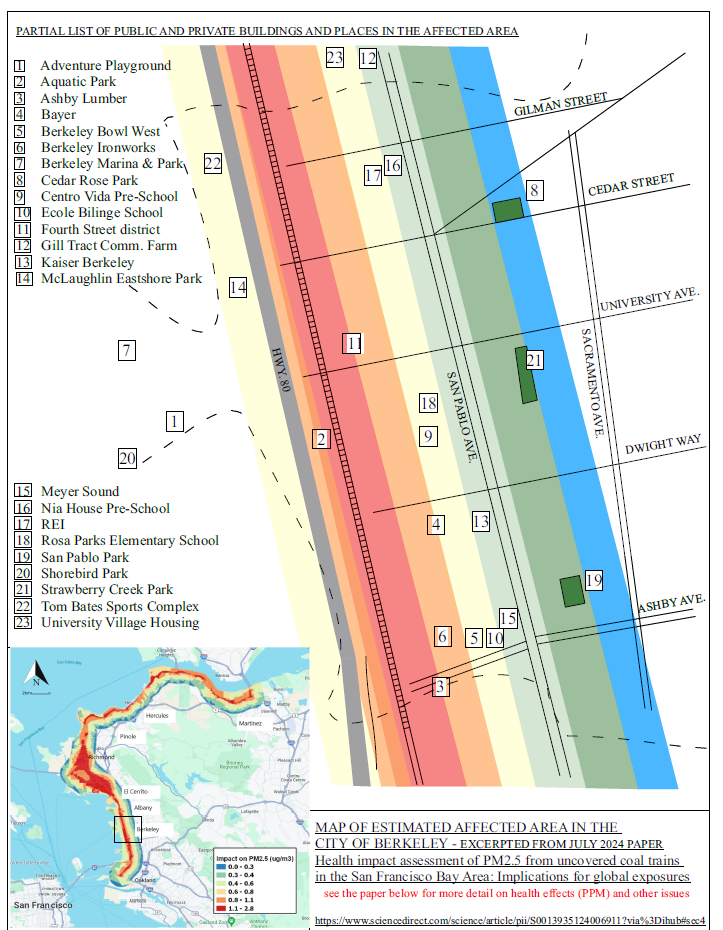
The image (map) at the top of this article suggests the nuts-and-bolts impact of multiple, mile-long coal trains passing through Berkeley every day. Zooming in on a map that illustrates a peer-reviewed study in the journal Environmental Research, shown in the lower left corner of the image above, it makes clear just who and what will be poisoned in Berkeley by coal dust shed from those trains.
- Schools and medical facilities, including Centro Vida Preschool, Ecole Bilingue, Rosa Parks Elementary School, and Kaiser Berkeley.
- Playgrounds and parks, including Adventure Playground, Aquatic Park, the Berkeley Marina, Cedar Rose Park, McLaughlin Eastshore Park, San Pablo Park, Shorebird Park, Strawberry Creek Park, and the Tom Bates Sports Complex.
- Places we live and shop for groceries and grow our own food, including Berkeley Bowl West, the Gill Tract Community Farm, University Village (where thousands of UC Berkeley students and their families live, and whose community garden is right next to the train tracks), and all homes within a half-mile or so of the train tracks.
- Businesses and commercial districts, including Ashby Lumber, Bayer, Berkeley Ironworks, the Fourth Street shopping district, Meyer Sound, and REI.
These are only partial lists. But they make clear that the proposed West Oakland coal terminal is of paramount interest to the City of Berkeley and all its residents … for all kinds of reasons.
That’s why next week’s City Council vote to adopt a No Coal resolution matters. A lot.
Please come out Tuesday evening, 6:00 to 8:00 pm, to rally while the City Council votes, and to celebrate the hoped-for passage of the resolution. The City Council meets at the BUSD Boardroom, at 1231 Addison St. between Bonar and Curtis (map). Event details can be found here.