lora jo foo: Rest in Power
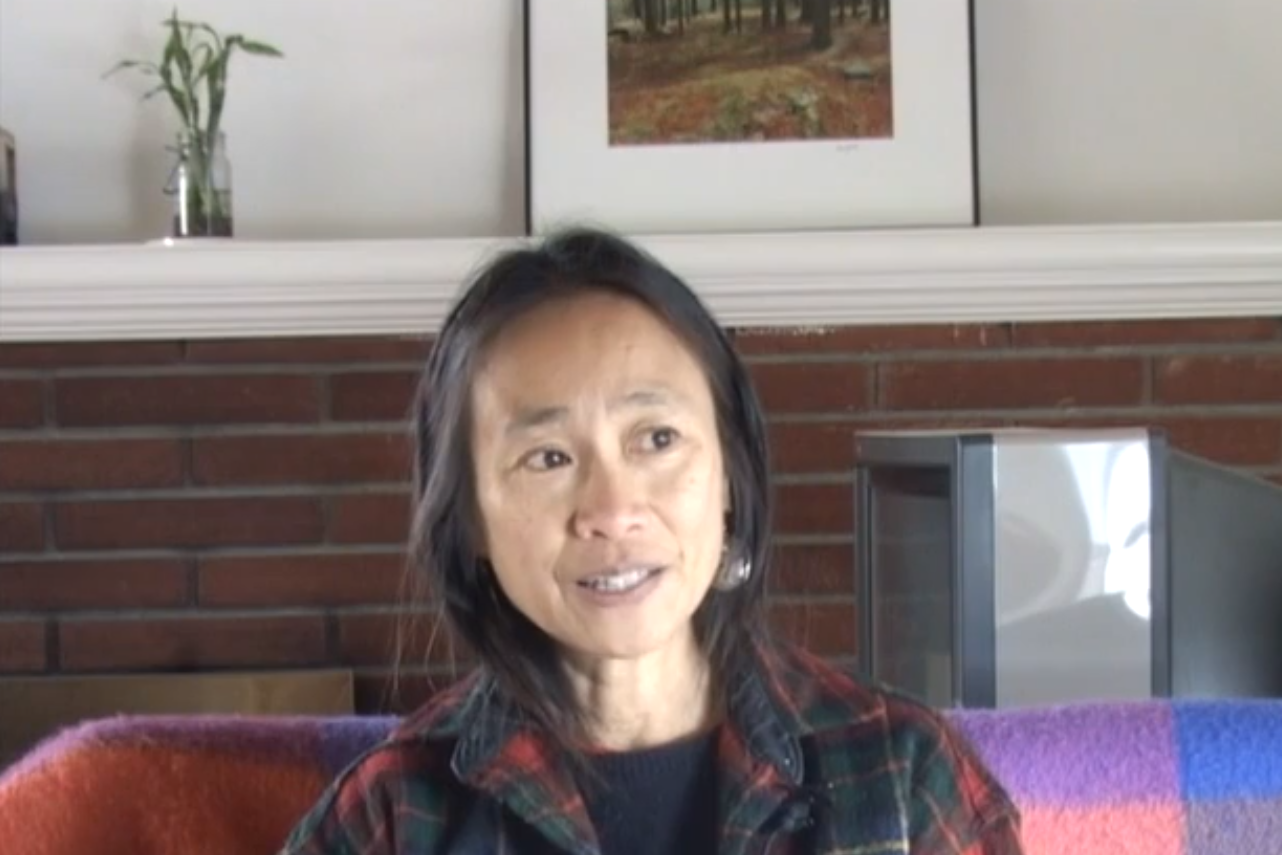
On March 13, 2026, No Coal in Oakland lost one of our leaders, our dear friend and comrade lora jo foo, who died at the age of 75 after a short illness.
lora jo contributed greatly to our success in keeping coal out of Oakland for 12 years and counting. She made history as an Asian-American activist, climate and environmental justice warrior, labor organizer, attorney, author, and photographer. As a leader of No Coal in Oakland, lora jo wore many hats: founding member, strategist, spokesperson, community organizer, lobbyist, researcher, recruiter, and legal analyst.
In 2015, while members of the Oakland City Council initially despaired of finding any way to prevent a coal terminal from being built in West Oakland, lora jo dug deep into the agreements signed between the City of Oakland and developers. She found a provision that allowed the City to ban coal provided it did so after holding a public hearing and amassing sufficient evidence of significant health and safety risks to workers and residents. A year later, this became the basis for a unanimous decision by the City Council to oppose the storage and handling of coal at the proposed terminal.
In 2023, lora jo left Oakland to join Pilgrim Place, a social justice oriented continuing care retirement community in Southern California.
In 2006, Loretta J. Ross recorded an extensive interview with lora jo for the Voices of Feminism Oral History Project. The introduction to the transcript of the interview chronicles lora jo’s story up to that time:
Lora Jo Foo was born in San Francisco in January, 1951, the fourth of seven daughters in an arranged marriage between Man Quen Ng and Hung Yea Foo. Her parents immigrated from China, her father as a “paper son” in 1938, her mother in 1948. As Lora Jo was growing up in Chinatown, her father worked in restaurants around the state, supporting the family only episodically, while her mother worked long hours in a garment factory. At age 11, Lora Jo followed her older sisters into the sweatshop, where she worked after school, weekends, and summers.
In high school, Foo protested educational tracking that denied her intelligence and blocked her aspirations. From 1968 to 1971, she participated in hippie culture, designed and produced clothing, and worked in the fishing industry in Alaska. Entering San Francisco State College 1971, she became involved in developing the new Asian American Studies curriculum and co-taught the first campus course on Asian American Women, an experience that solidified her politics as a Marxist and a feminist. Foo dropped out of college to organize immigrant women workers, combining manual labor with union activism.
As a seamstress and shop steward from 1975 to 1978, Foo used her bilingual skills to increase rank and file Chinese-speaking women’s understanding of and participation in the International Ladies Garment Workers Union (ILGWU). From 1978 to 1981, she worked as a hotel room cleaner and shop steward in the Hotel and Restaurant Employees International Union, where she challenged racial discrimination in the allocation of jobs and represented Filipina, Latina, and African American maids in a 1980 citywide strike.
Foo entered Golden Gate University School of Law in 1982. After graduation, she worked for private labor law firms before becoming Director of Employment/Labor Project at the Asian Law Caucus in San Francisco, where she litigated key cases involving sweatshop industries from 1992 to 2000. In 1995 she formed Sweatshop Watch, an educational and advocacy coalition of women’s groups and labor organizations that monitors human rights and civil rights violations in the garment industry. She remains on the board. In 1996 Foo became a co-founder of the National Asian Pacific American Women’s Forum (NAPAWF).
Foo earned an M.A. in Public Administration at the Kennedy School of Government at Harvard University in 2002. During the 2004 presidential election, she served as national coordinator of the AFL-CIO Voting Rights Protection Program [and, later, as] Northern California Organizing Director of the California Faculty Association.
Foo is the author of Asian American Women: Issues, Concerns, and Responsive Human and Civil Rights Advocacy (2002; 2nd ed. 2007). In recent years she has taken up nature photography as a means of accessing and expressing childhood experiences and emotions.
Her nature photography and revisiting of her childhood came together in the 2008 publication of lora jo’s second book, Earth Passages: Journeys Through Childhood, juxtaposing vignettes of a Chinese American childhood in an inner city urban ghetto with color nature photographs lora jo took as an adult.
In 2019, Hui Yu, a PhD candidate at the University of Auckland in New Zealand, submitted a dissertation entitled Lora Jo Foo: Activist and Advocate for Immigrant Women Workers in the USA, 1951-2003. The author’s book-length thesis reflected on broader themes of history and the Asian American experience while pivoting around the life of lora jo:
[This is] a story of a woman warrior whose strategies of advocating for immigrant women workers evolved through years in the decline of the labor movement and the period of conservative backlash. It was in this arena that Lora Jo Foo made an impact….
Foo’s evolving strategies were based on her belief that “only when immigrant women and women of color engage in class struggle and fight for their economic rights will their oppression end.” This belief stemmed from her family background and experiences, was influenced by her participation in Third World activism of the late 1960s and early 1970s, and–as it turned out–would mirror the later theoretical concept of “intersectionality”.
Former Acting U.S. Secretary of Labor Julie Su, who collaborated with lora jo in the 1990s and became a very close friend, posted an eloquent tribute to lora jo’s life and legacy in which she reminds us of one of lora jo’s favorite sayings: “If at first the idea is not absurd, then there is no hope for it.”
That was the spirit lora jo brought to our campaign back in 2015 when the City’s politicians had nearly resigned themselves to a dystopian future in which Oakland would submit to hosting the largest coal export facility on the West Coast.
lora jo foo will be with us as we continue our fight for a coal-free future.
==============
Featured image at top (screenshot from video of interview) Credit: Loretta J. Ross.
Copies of lora jo’s Earth Passages: Journeys Through Childhood are available through the Oakland Public Library. Several years ago, lora jo donated her papers to Smith College where they are now archived in the Sophia Smith Collection.
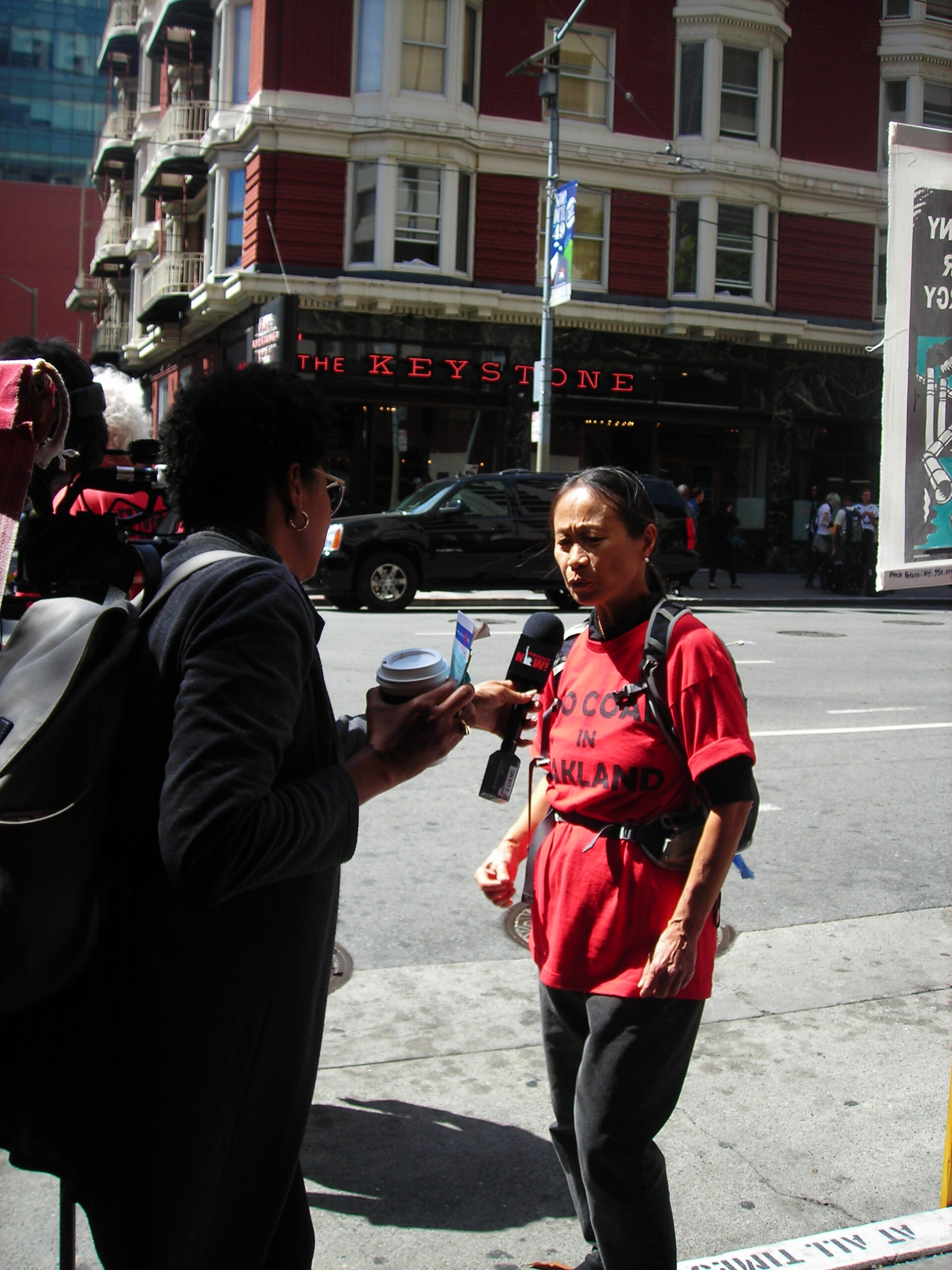
NCIO organizer lora jo foo speaks with a reporter at the Principles for Responsible Investment Conference picket in San Francisco, (Sept 12, 2018). Photo credit: Kathy Kojimoto.