Environmental Justice
The proposed coal terminal in West Oakland would have devastating health impacts for everyone in the path of coal trains along the East Bay shoreline, but it would hit communities of color and working-class communities the hardest—neighborhoods that are often dismissed as “sacrifice zones.”
These communities are sacrificed by design: rail lines traditionally cut through neighborhoods that were redlined (a racist policy in which banks and federal agencies denied communities of color loans and other services) and thereby engineered to be segregated politically and socially for generations.
And yet, for as long as there has been injustice and systemic neglect in the Bay, there has also been fierce community resilience and resistance: frontline communities in Richmond fighting against the Chevron Refinery, in Martinez against the Martinez Refining Company, and in Treasure Island and San Francisco’s Hunter’s Point against contamination from former military sites, to name a few.
Although this page focuses on Oakland and the East Bay, our struggles and stories are connected (as our land, water, air, and humanity are connected), and we are deeply grateful to be part of a long lineage of local, people of color-led environmental justice movements.
West Oakland rises up against environmental racism
West Oakland is a beacon of perseverance and hope in the environmental justice movement. The community’s deep-rooted, Black-led grassroots organizing draws from its rich history and culture—the Black Panthers, art, and blues—and decades of resilience against racist policies and corporate polluters.
The West Oakland Environmental Indicators Project (WOEIP) was founded by community leaders like resident, activist, and grandmother Ms. Margaret Gordon to address the rampant air pollution in her neighborhood and its health effects on her loved ones.
WOEIP’s resident-led research turned a spotlight on what Black, brown, and working-class neighborhoods have always known: that institutional racism and predatory capitalism create a disproportionate public health crisis in communities of color.
In the U.S., communities of color are hit the hardest by air and water pollution from freeway traffic, heavy industry, chemical waste, and toxic soil [1]. This can look like the routing of an oil pipeline so that it endangers sacred sites and water upon which Indigenous American communities depend (Standing Rock, ND) [2], or the neglect of infrastructure that has exposed a majority-Black city to severe and debilitating lead poisoning (Flint, MI) [3]. For West Oakland, it looks like the disturbing statistics revealed by WOEIP’s investigations:
Compared to the county average,
- the average West Oakland lifespan is 2 years shorter [4]
- asthma hospitalizations in West Oakland are nearly 50% higher [5]
- West Oaklanders die from heart disease at a rate 33% higher [6]
West Oakland’s air is improving. . . but the coal terminal threatens progress
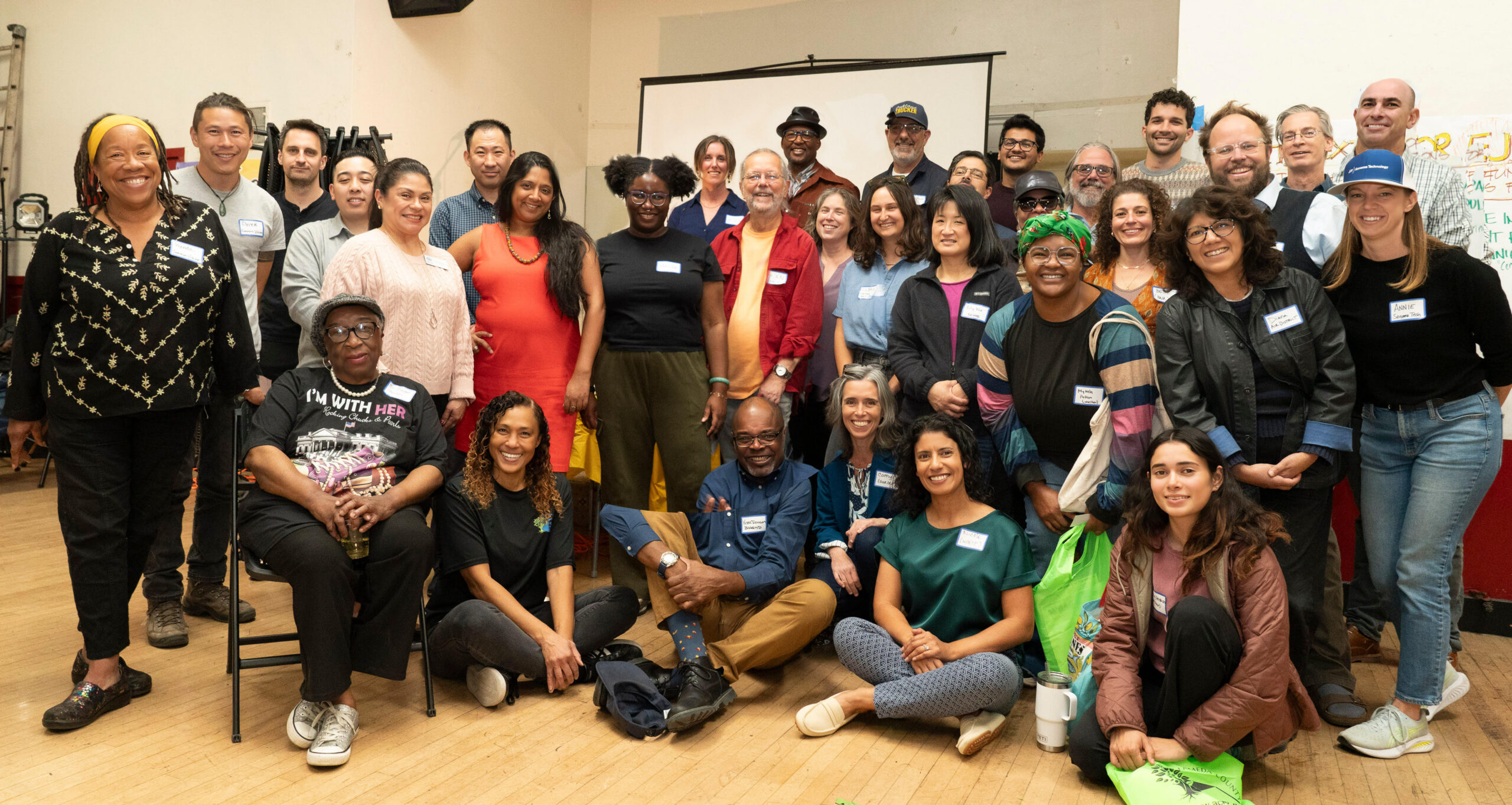
WOCAP Steering Committee members, community participants, and WOEIP staff at the WOCAP town hall in 2024.
Fast-forward WOEIP’s decades of research, advocacy, and hyper-local organizing to the unveiling of the West Oakland Community Action Plan (WOCAP) in late 2019: a community-led blueprint for reducing air pollution in West Oakland.
WOCAP was made possible by California’s Assembly Bill (AB) 617 legislation, which directs air regulators to work closely with communities facing disproportionate air pollution and poor health to develop solutions together. Its pioneering model is an inspiration and reference framework for policy groups and impacted communities across California and the country.
The plan details over 80 strategies to improve West Oakland’s air quality, ranging from reducing diesel truck idling at the Port of Oakland, to engaging in environmental review processes for new development projects, to planting more trees.
WOCAP has made big progress over its first few years:
- Cancer risk is down 54% across West Oakland
- Diesel particulate matter is down in 6 of 7 West Oakland impact zones
- $51 million has been invested in emissions reduction projects
Check out more of WOCAP’s 5-year progress here.
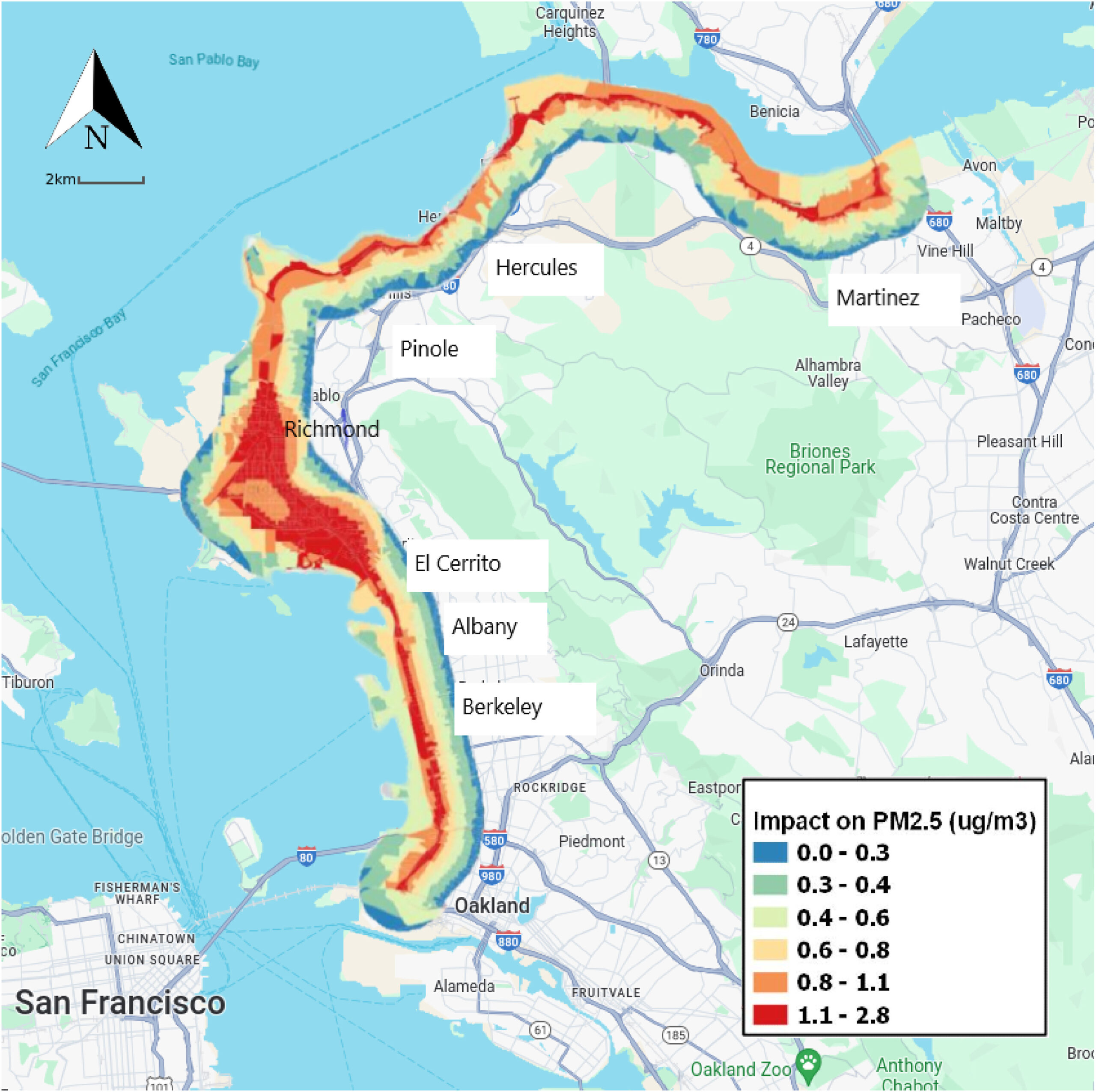
Operation of the proposed coal terminal at the foot of the Bay Bridge would unspool West Oakland’s hard work to create a safe and thriving home for all: its elders and families, its refugees and artists, its activists and small business owners. Transport of coal to the terminal would also affect many communities outside of West Oakland—check out the map, below, to see coal’s potential impact on where so many of us live, work, and play (and this website’s summary of the peer-reviewed article from which the map is sourced).
Environmental justice IS climate justice
To be clear, there is no “safe” level of exposure to coal dust (just as there’s no such thing as “clean coal” [7]): all coarse particles and tinier, invisible PM 2.5 (particulate matter that has a diameter of 2.5 micrometers or less), cause significant adverse health effects by lodging deep in the lungs, scarring tissue and causing oxidative stress in cells [8].
Allowing the coal terminal to be built would not only usher in further asthma, heart disease, hospitalization, and death [9] but would contribute to climate consequences we’re already witnessing here in the Bay: more extreme weather patterns, wildfires, and heat. More than 1 billion tons of CO2 could be added to the atmosphere [10] if this terminal is built, further fast-tracking the kind of climate breakdown that’s become our planet’s “new normal”: toxic sea level rise, the spread of disease, and increasing food shortages and numbers of climate refugees.
The construction of this coal terminal has never just been about Oakland or the many Bay Area neighborhoods connected by the rail lines; because of our greater interconnectedness on this beautiful and finite planet, what happens here ripples outward.
Already, the Global South as well as communities in the Global North that have been traditionally excluded from wealth and power have borne and will bear the worst of the climate crises’ effects—past, present, and future [11]. People in lower-income countries are five times more likely than those in high-income countries to be displaced by sudden extreme weather disasters [12], and those disparities will likely widen as our weather patterns become increasingly unstable.
Investing in coal means investing in an increasingly toxic and climate-burdened future [13]; it means stealing from the health and possibilities of future generations—locally and across the globe.
We won’t let the coal terminal pull us backwards
No Coal in Oakland stands together with activists and allies who are fighting for environmental justice, climate justice, and collective thriving in Oakland, throughout the Bay, and beyond.
Just as the UN General Assembly declares access to a clean and healthy environment as a universal right, we believe that access to clean air, water, and land is a fundamental right of ALL people [14]. To deny such rights constitutes an injustice that we will not tolerate. Although today we’re fighting coal in Oakland, this is just one front of a powerful movement to reclaim our health, our planet, and our futures for the people. Join us!
###
Notes
[1] “Study Finds Exposure to Air Pollution Higher for People of Color Regardless of Region or Income,” United States Environmental Protection Agency, Sept. 20, 2021, https://www.epa.gov/sciencematters/study-finds-exposure-air-pollution-higher-people-color-regardless-region-or-income and “Communities of Color Across the US Suffer A Growing Burden from Polluted Air,” Milken Institute of Public Health at the George Washington University, March 6, 2024, https://publichealth.gwu.edu/communities-color-across-us-suffer-growing-burden-polluted-air
[2] “Treaties Still Matter: The Dakota Access Pipeline,” Smithsonian: National Museum of the American Indian, https://americanindian.si.edu/nk360/plains-treaties/dapl.cshtml and Dakota Access Pipeline Protests, Wikipedia, https://en.wikipedia.org/wiki/Dakota_Access_Pipeline_protests
[3] Flint water crisis, Wikipedia, https://en.wikipedia.org/wiki/Flint_water_crisis/
[4] West Oakland Environmental Indicators Project, https://woeip.org/about-woeip/
[5] West Oakland Community Action Plan: 5th Year Annual Report, October 9, 2024, https://woeip.org/wp-content/uploads/2024/11/WOCAP-Year-5-Progress-Report.pdf
[6] West Oakland Environmental Indicators Project, https://woeip.org/featured-work/owning-our-air/health-living-buffers-strategies/
[7] Matthew Glasser, Isabella Murray, and Daniel Peck, “Trump may tout coal as clean, but experts say there’s no such thing,” ABC News, June 4, 2026, https://abcnews.com/US/trump-tout-coal-clean-experts-thing/story?id=133588452
[8] Amir Eskanlou and Barbara J Arnold, “Toxicity of respirable coal dust: An overview of origin, chemistry, mechanisms, and possible remedies,” International Journal of Coal Science and Technology, January 5, 2026, https://pmc.ncbi.nlm.nih.gov/articles/PMC12769589/
[9] “New study: Oakland coal terminal would bring asthma, heart disease, hospitalization, and death,” No Coal in Oakland, April 20, 2024, https://nocoalinoakland.info/new-study-oakland-coal-terminal-would-bring-disease-and-death/
[10] Earthjustice, letter to City of Oakland, Sept. 2, 2015, https://nocoalinoakland.info/wp-content/uploads/2016/02/Earthjustice_Letter_to_Oakland_City_Administrator_09-02-2015.pdf
[11] “EPA Report Shows Disproportionate Impacts of Climate Change on Socially Vulnerable Populations in the United States,” United States Environmental Protection Agency, Sept. 2, 2021, https://www.epa.gov/newsreleases/epa-report-shows-disproportionate-impacts-climate-change-socially-vulnerable
[12] “Climate Change and Inequality,” Oxfam, https://www.oxfamamerica.org/explore/issues/climate-action/climate-change-and-inequality/
[13] “Limiting Overshoot Spotlight Report,” United Nations Environment Programme, September 2, 2026, p. 49, https://wedocs.unep.org/items/156d074c-ab1d-4833-acf8-6343589ede9b
[14] “UN General Assembly declares access to clean and healthy environment a universal human right,” United Nations, July 28, 2022, https://news.un.org/en/story/2022/07/1123482
Image credit: “Fig. 1. Study Area with Estimated PM2.5 Concentrations associated with 2.1 μg/m3 Increase in the Peak of the Annual Average Increment,” from Health impact assessment of PM2.5 from uncovered coal trains in the San Francisco Bay Area: Implications for global exposures, Environmental Research v252 Part 1. https://doi.org/10.1016/j.envres.2024.118787