EJ Groups Demand Fresh EIR to Assess Impact of Coal Export Terminal
24-year-old Environmental Impact Report and 14-year-old update never even considered coal shipment from West Gateway
For more than a decade, the fight over a proposed coal export terminal at the old Oakland Army Base has played out mostly in courtrooms and City Council chambers. Now, with the Trump administration dangling $75 million in federal money to help get the project built, the battle is shifting to a less visible but potentially decisive arena: the office of the Bay Area Air District — and to a fight over a single, deceptively technical question. Is the developer allowed to build on the strength of an environmental study written in 2012, or does the law require regulators to take a fresh look first?
The developer’s position is that the matter is settled: the existing environmental review is final, no further study is legally required, and the project should be able to proceed to construction on that basis.
Attorney Colin O’Brien of Earthjustice argues the opposite, in a detailed letter sent July 6 to the Air District’s top two officials — Executive Officer Philip Fine and General Counsel Sandy Crockett — laying out a roadmap for how the regional air agency should handle the project once a formal permit application arrives. The letter was filed on behalf of Earthjustice, the West Oakland Environmental Indicators Project, San Francisco Baykeeper, and the Sierra Club, and draws heavily on the terminal developers’ own promises to make its case. The letter details many instances where developers have already pledged in sworn court testimony, expert reports, and letters to the City of Oakland to use specific pollution-mitigating technology and to defer to the Air District’s regulating authority.
The assertion at the heart of the letter — that state law requires a brand-new environmental study before any permit can be issued — is quickly becoming the next rallying point for the environmental and climate justice groups that have spent a decade fighting the project. It reframes what might otherwise be an obscure procedural dispute into a concrete, winnable ask: no new study, no permit.
Why the Air District matters so much
The project has changed hands and names over the years, but it’s currently being pushed by Oakland Bulk & Oversized Terminal, LLC (OBOT) and Insight Terminal Solutions (ITS). Back in 2015, Oakland’s City Council tried to ban coal handling within city limits outright. OBOT sued and won, successfully arguing in federal court that the ban wasn’t necessary because the Air District’s own permitting process would catch any dangerous pollution before it could hurt residents.
That argument is now coming back to the developers’ doorstep. The letter compiles a long paper trail of OBOT’s courtroom statements affirming that it cannot build or operate the terminal without two separate approvals from the Air District — an “authority to construct” and a “permit to operate” — and that the agency has broad discretion to impose whatever conditions it deems necessary. OBOT’s own expert witness told the court the Air District could limit throughput, dictate pollution-control technology, and even restrict what grade of coal moves through the facility. The federal judge who heard the case agreed, writing that the Air District “has a fair amount of latitude” and “can impose almost any condition that it deems necessary.”
In other words: the Air District has the power to hold the developers to their own prior promises.
The core fight: is a new environmental study legally required?
Underneath the legal terminology, this is the argument organizers will likely rally around: the developer says the environmental review is done and final; Earthjustice says the law requires the Air District to order a new one before any permit can be issued.
The relevant law is the California Environmental Quality Act, or CEQA, which requires government agencies to study a project’s environmental impacts before approving it. The City of Oakland conducted its environmental review of the broader Army Base redevelopment back in 2002, with a follow-up addendum in 2012. The developer’s position — stated in past litigation — is that this 14-year-old review satisfies CEQA once and for all, that no further permits requiring discretionary city review remain, and that no legal basis exists to reopen the environmental analysis.
Earthjustice’s letter argues that position collapses the moment coal enters the picture, because neither of the existing studies seriously grapples with coal. The 2002 study didn’t contemplate a bulk shipping terminal at all — it envisioned light industrial and office space. The 2012 addendum acknowledged a “working waterfront” concept but never specified that coal would be the commodity moving through it, and described only vague “non-containerized bulk goods.” Neither document examines the dust generated by day-to-day coal operations — loading rail cars, moving coal along conveyors, loading ships — which outside research has since identified as a serious threat to nearby residents’ lungs, much more so than the construction-phase dust examined in the old studies.
That omission is precisely the kind of gap CEQA is built to catch. Under the law, when a project changes materially, or new information emerges that existing studies never considered, a lead or responsible agency must order a new Environmental Impact Report — the formal study, referenced in the letter as an EIR, that CEQA requires before approvals can move forward. Earthjustice’s letter lays out several independent triggers for exactly that kind of new review:
- The commodity itself was never studied. Coal, and its fugitive dust, simply does not appear in either the 2002 or 2012 analysis.
- The project has apparently grown. Federal officials now describe a facility built to handle 9 to 10 million tons of cargo a year — or more — compared with the roughly 4 million tons implied by the 2012 study’s shipping estimates.
- The science and the standards have moved. Federal air quality standards for fine particulate matter have gotten stricter since 2012, the research linking that pollution to heart and lung disease — and even COVID-19 mortality — has grown substantially, and the Air District has updated its own pollution-significance thresholds more than once since the original study was written.
- Climate impacts were barely addressed. The 2002 EIR didn’t address greenhouse gases at all, and the 2012 addendum, while it calculated local emissions that exceeded the thresholds then recommended by the Air District, concluded there was no significant impact because the Air District had not established any greenhouse gas thresholds when the initial 2002 EIR was adopted.
Taken together, Earthjustice argues, these gaps don’t just weaken the old studies — they trigger CEQA’s renewed review requirement as a matter of law. And notably, the letter points to past legal filings in which OBOT itself acknowledged that new information or a significantly changed project can force exactly this kind of do-over — while separately maintaining that none of those triggers apply to its own project.
Even if the City of Oakland fails to initiate renewed environmental review, the letter insists, the Air District’s own permitting decision is itself a fresh discretionary act — one that legally cannot rely on a study that never once mentions coal. As the Earthjustice letter demonstrates, the Air District has the power to require a new study. With support and engagement from community groups, staff will hopefully recommend that the Air District board do so and a subsequent EIR that will result in rigorous measures to protect public health and safety.
Holding developers to their own blueprint
Perhaps the most concrete section of the letter is a punch list of pollution controls that OBOT has repeatedly told courts and the city it intends to build — and that Earthjustice says the Air District should write into any permit as binding requirements, not just talking points. Among them: covered rail cars, fully enclosed conveyor systems and storage buildings, bottom-dumping rail cars designed to prevent spillage, water or fog-based dust suppression at every transfer point, and a commitment to handle only less-dusty grades of coal. The letter argues that because OBOT has already told a federal court it would build a “state-of-the-art” facility incorporating these features, the Air District should treat them as the baseline for what regulators call “Best Available Control Technology,” rather than allowing a scaled-back facility design to slip through.
What happens next
The Air District has not yet received a formal permit application for the terminal, and for this reason the letter is explicitly a preview — Earthjustice says it “reserves the right” to expand its arguments once an actual application is filed. But by putting the agency on notice now, and by cc’ing the Air District’s Board of Directors and senior enforcement staff, the letter signals that community and environmental groups intend to make the fight for fresh environmental review, not just the fight over the dubious legality of the federal grant, the next major front in the decade-long effort to keep toxic coal dust out of West Oakland and other vulnerable East Bay communities.
For residents who have organized for years against the project, the letter offers something new: a legal argument built almost entirely from the developers’ own words, aimed squarely at the one agency both sides agree may hold the final say. And it offers something else, too — a clear, concrete demand around which to organize. Where the developer insists the environmental record is closed, Earthjustice and its allies are now making the case, loudly and convincingly, that the law requires it to be reopened. Expect “new EIR” to become the phrase community groups repeat at Air District hearings in the months ahead.
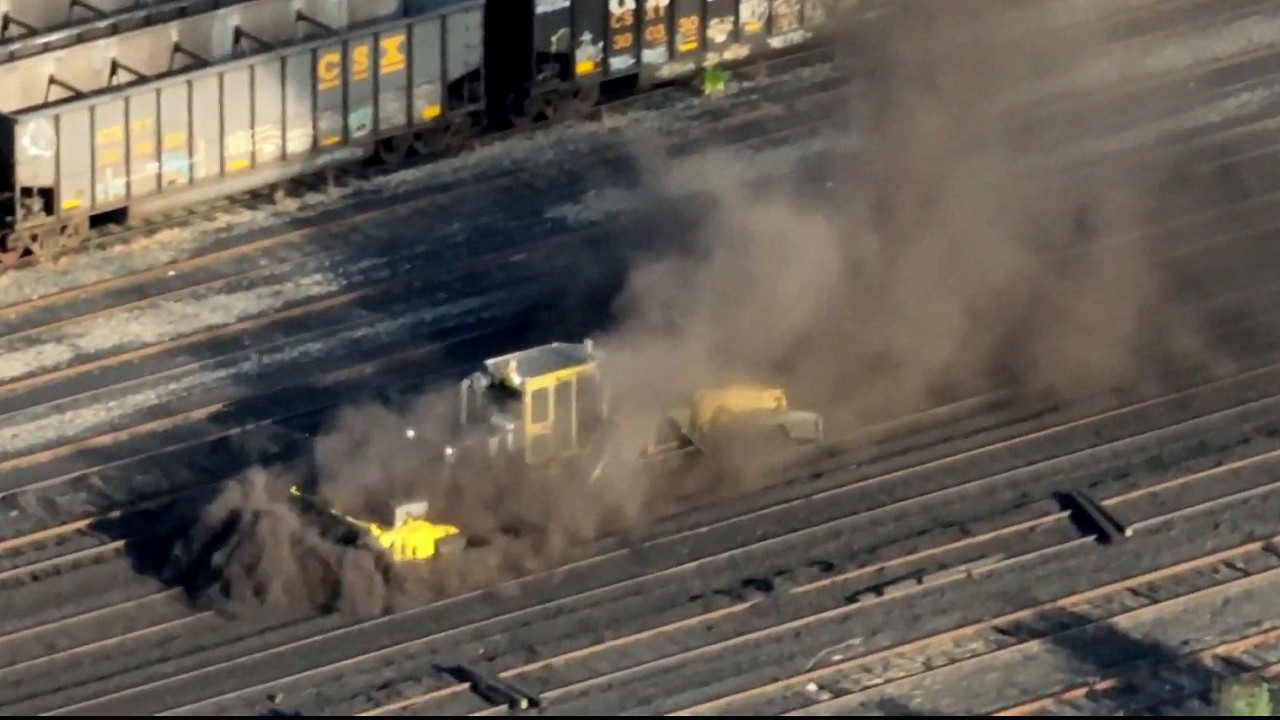
Image at top: A track maintenance vehicle churns up coal dust September 5, 2024 at the CSX Coal Terminal in Curtis Bay, Baltimore. MD. Community member’s drone photo courtesy of BaltimoreBrew. See New study strengthens link between CSX coal terminal and air pollution in Baltimore’s Curtis Bay.